
Adapt & Grow – at the Speed of Change

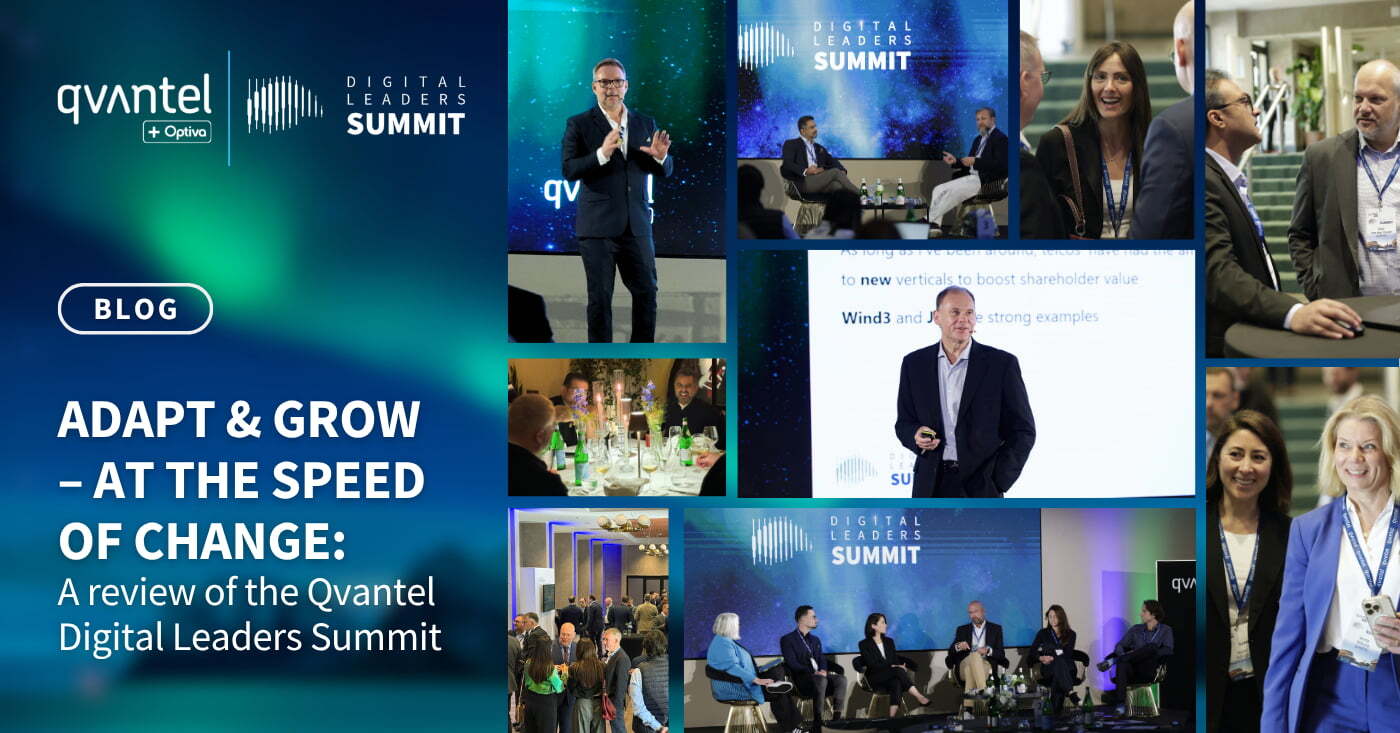
A review of the Qvantel Digital Leaders Summit
The Qvantel Digital Leaders Summit took place in Rome on 3rd November and brought together operators, analysts and technology partners to talk about the changes that are driving our industry. What made the day special, was the openness, how willing people were to share what they are working on in the rapidly changing business and tech landscape, and where they see opportunities, and that made the discussions practical rather than promotional.
A market reinvention and a return to growth
Camille Mendler of Omdia opened by describing a market that is reinventing itself, with some of the largest digital customers for CSPs having appeared only in the last five years and a growing share of customers now being machines rather than people. The market is growing and as well as changing. Omdia expects connectivity revenue to reach $1.5 trillion by 2030, and noted that almost a third of telco revenue already comes from beyond connectivity. Camille described a B2B market heading towards its next trillion, with cybersecurity, GPU as a service, slicing and satellite among the areas she highlighted. Operators are responding to this opportunity, with eight in ten prioritizing B2B for technology investment and 48% expecting to bill for AI tokens within 18 months. Enterprises are also turning to telcos for guidance on sovereign infrastructure and AI, and Camille pointed out that companies that view network sovereignty as important view telecoms operators as their most trusted AI partner. In her view, operators who combine speed, simplicity and trust will be well placed to benefit.
Tero Kivisaari, President of Qvantel, discussed the operator industry landscape, and made the case for change. He mentioned that many telcos are starting to enjoy increased revenue growth and that this is going to increase as telcos are turning the ambition to move into new verticals to lift shareholder value into reality. Tero gave WindTre and Jazz World as strong examples of operators that have done so. He described Qvantel as changing in step with its customers. In the last year Qvantel acquired Optiva and has grown significantly. We now have over 70 customers, are recognized by leading analysts, offer a full-stack BSS, and are bringing AI into both our product and delivery.
The topic of change in the industry continued when WindTre CEO, Benoit Hanssen took to the stage. I had the pleasure of sharing the platform with Benoit and we discussed how WindTre is driving growth. For both consumers and business customers WindTre has gone far beyond offering just connectivity and provide services such as energy, insurance, home security for consumers and technology services to enterprise customers. It was good to hear Benoit’s viewpoints on importance of being nimble and fast, in exploring and rolling new services out to consumers, and in building growth in rapidly evolving landscape of AI, 5G and B2B as well.
Demonstrations in Rome
Next up was Qvantel CTO, Topias Koskimäki who provided live demos that showed how an AI-native BSS and agents work with grounded real-time data to generate new revenues for operators. In the B2B example, he showed how operators can use data and AI to drive monetization of 5G AI slices and so play a larger role in the AI value chain. He showed how agents combined network and event data to identify candidate sites for 5G slice and edge-based AI computing offers, identified sales targets and drove reach-out for meeting booking campaigns. Also, the joint solution between Qvantel and Nokia for “5G AI Slice” monetization was also demoed by Nokia and Qvantel teams during the breaks. In the B2C example, he showed how network and BSS data showed foreign visitors running out of roaming data. Agents then used this data to create a Rome Tourist eSIM offer and market it to visitors to Rome. Topias summed it up by saying that the same data foundation supports these use cases, and that agents are only as good as the data they work with, and for that reason data foundation needs strong focus at CSPs, which is an area Qvantel can help as well.
Satellite Partnerships and new use cases
Carmen Reglero Andres of Amazon Leo talked about how satellite and terrestrial networks can complement each other. She referred to Vodafone's agreement to extend mobile coverage across Europe and Africa and to the collaboration between AT&T, AWS and Amazon Leo, and she listed the areas where demand is strongest - including rural connectivity, emergency response, hybrid cloud, cybersecurity, edge AI and connected assets. The rapidly evolving satellite industry landscape stirred plenty of discussions among participants.
Panels and fireside chats
The panels and fireside chats looked at where operators can go next. The first panel, on how AI is accelerating innovation for CSPs, included speakers from Google, Amazon, Qvantel, DNA and WindTre, while the second, on the new competitive edge for CSPs, included Nokia, BH Telecom, Jazz World, ByteLens and Qvantel. In the fireside chats, Qvantel's Salman Tariq spoke with Dr. Khurram Durrani about the role people will play in an AI-shaped workforce and how operators can help local communities benefit from AI, and then with Yousef Alqatami, CFO of 1Global, about what large non-telecom brands entering the digital and AI economy mean for CSPs and how wholesale growth can support shareholder value.
The value of open conversation
Because the speakers and audience were willing to talk openly, the day went beyond the usual presentations. In the end of the day, we engaged into teamwork in tables for ideating and sharing views on most potential bets telcos should look next for driving next step in delivering growth and shareholder value. We would like to thank all of the speakers and attendees for taking part and look forward to continuing these conversations at the next summit.
Let's adapt and grow, at the speed of change!
Jukka Heiska
CMO, Qvantel